
A Private-Sector Job Primer for FSOs and Other State Department Denizens
Blind spots Foreign Service Officers hit on the way to private-sector jobs or consulting: titles, P&L roles, equity, rate setting, and who to work for.

Blind spots Foreign Service Officers hit on the way to private-sector jobs or consulting: titles, P&L roles, equity, rate setting, and who to work for.

I'm working on materials for my course at George Washington University this year. One of the fundamental questions that I keep wrestling with is the distinction between foreign policy and diplomacy. I think too often the two get conflated, positioning diplomats to do both policymaking and policy execution.
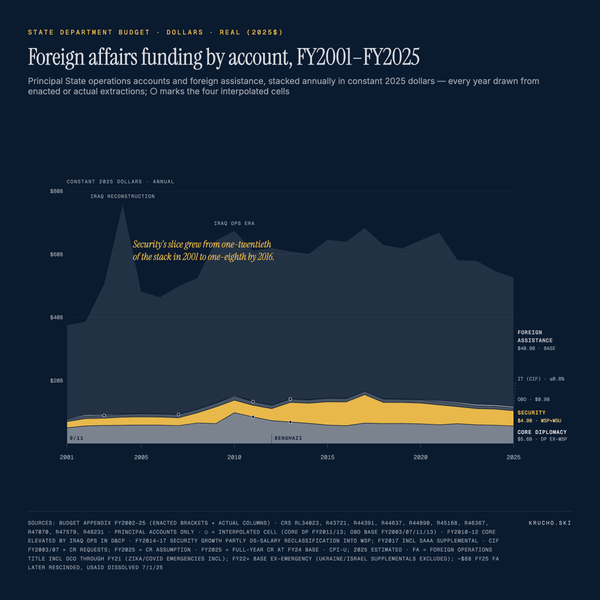
A quick look at the balance of State Department's funding over the last 25 years. There are a lot of myths in the State Department community, and some of the biggest are about spending, staffing, and where the money actually goes. Proponents of diplomacy and development rightly argue
A conversation on Public Diplomacy Examined (IPDGC, GW) about what AI changes in diplomacy — and what it makes more valuable than ever.

I just finished Dan Spokojny’s great article “Should Diplomats Trust AI?” The piece is anchored by two new items: the recent Foreign Service Journal issue that focused heavily on AI (which I contributed to), as well as the December 2025 AI-Powered Diplomacy paper from the Pavel Slunkin writing

The skills that got you promoted are often the ones that will undermine you next. This is a guide to the three career transitions that change what effectiveness means — from individual contributor to manager, from manager to leader of leaders, and the inner work that makes the difference.

I was about seven years into my career before I had a manager who did regular 1:1s with me, not the quarterly check-ins or annual reviews I was used to, but actual recurring conversations about work, about thinking, about how things were going. About four months in, we

DoW designated Anthropic a supply-chain risk. If you built workflows around Claude Code, here's how to protect your investment by running two AI tools against one shared vault.

The DoW designated Anthropic a supply-chain risk. If you built workflows around Claude Code, here's how to protect your investment with portable, vendor-agnostic AI setups.

Enterprise AI doesn't have to repeat the oldest mistake in IT. A three-layer model — shared data, standardized skills, and personalized agents — lets organizations amplify individual judgment instead of standardizing it away. The technology exists today.

Feedback built on aggregated impressions — "multiple people have raised concerns" — strips away everything that makes feedback useful. The research is clear: effective feedback is specific, actionable, and timely.

Most LinkedIn advice falls into one of two categories: tactical tricks that aim to game the system or vague encouragement to "post consistently and engage authentically." Neither helps you understand how the platform actually works, which is what you need to make good decisions about your own strategy.

feedback
For the reasoning behind this system, see Why Feedback Order Matters: A System for Document Review. The Three Tiers TierScopeAddressExamplesHigher Order (HOC)Whole documentFirstArgument, structure, purpose, audience fit, completenessMiddle Order (MOC)Sections/paragraphsSecondTransitions, evidence integration, tone, proportionalityLower Order (LOC)Sentences/wordsLastGrammar, spelling, word choice, formatting The core rule: Always work

writing
Bad document feedback was the bane of my existence at the State Department. (We always talked about "happy to glad" changes). You've probably seen this happen. Someone sends a draft for review. The first reviewer opens it, spots a comma splice on page one, fixes it,

LinkedIn's algorithm has never been intuitive for users of other social media platforms: from its preference for once-a-day posting to how it values different forms of engagement. This got even more complicated in late 2025, when LinkedIn launched the 360Brew algorithm, a 150-billion parameter language

claude-code
Every conversation with AI starts from scratch. This tutorial builds the system that fixes that — persistent context, project memory, and a personal vault that makes each session smarter than the last. Built for diplomats, analysts, and federal professionals who need more than a chatbot.

AI
This guide walks you through setting up an AI agent with persistent memory, modular skills, tool integration, and task automation, without exposing endpoints to the internet. Time required: ~2 hours Difficulty: Comfortable creating folders and text files; some terminal use helpful but not required Prerequisites: macOS/Windows/Linux, Anthropic API
AI
Two weeks ago, the Pentagon put Google's Gemini for Government on the desktops of 3 million military personnel, civilians, and contractors. If you have a CAC, you now have access to a frontier AI model cleared to handle CUI. Most people will poke at it a few times,

organizations
This is for teams who know their coordination is a mess but don't have the energy for another change initiative. If you've been putting off "fixing how we track work" because it sounds exhausting, this is the smallest-possible-steps version. You can feel

change management
If you've worked in consulting or government transformation, you've probably encountered kaizen - Toyota's continuous improvement philosophy that revolutionized manufacturing. You might know the Lean methodology it spawned. But there's a less famous Japanese management practice that may matter more for organizational change:
AI
We all sometimes need to check up on what is published about us (or a friend, colleague, or potential partner) online. While you can certainly ask Claude or another LLM to do your research, it will work far better if you tell it exactly what you are after... Wayan Vota

I've always loved LinkedIn as a content platform. Not ironically. I know that's an unfashionable opinion. The site gets mocked for performative thought leadership and quasi-work-related trash. But I find the platform hugely valuable for discovering new thoughtful people and for sharing my own

Technology
A practical guide for getting more out of Claude and ChatGPT (and written based on conversations last week!) There's a counterintuitive truth about working with AI that took me a while to internalize: more isn't better. Not more training data, not more context, not more conversation
Technology
I spent three hours last Tuesday fighting with PowerPoint over text box alignment. Three hours. This is absurd, and we all know it. But most of the "AI solutions" aren't actually solving the problem. They're trying to help you think, communicate, and format all